


18-Pound Cannon
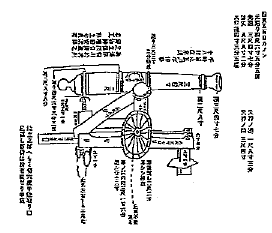
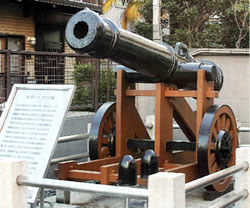
This cannon was made in Kaei 5 (1852), near the end of the Edo period, at the request of the Tsugaru Domain, now Aomori Prefecture. Yasujirō Masuda, a renowned Kawaguchi foundry craftsman and the first generation of the Masuda family, worked with Shūhan Takashima, who later became a gunnery magistrate, to make the casting of large cannons possible. From Kaei 5 to Ansei 5, 213 cannons and 41,323 shells were produced and supplied across Japan. Moving from everyday castings such as pots and kettles into cannon casting must have been a tremendous challenge. That spirit of challenge continues today in our development of grinding machines.
- Overall length: 3.5 m
- Weight: 2.5 tons
- Caliber: 15 cm
- Range: 2,500 m
Yasujirō Masuda and Cannon Casting
As national defense became urgent, Kawaguchi foundry craftsmen began casting not only everyday pots and kettles, but also weapons.
Among them, Kintarō Masuda and Yasujirō Masuda cast coastal-defense cannons, and in recognition of their achievements were permitted to use a family name. In Ansei 6 (1859), Shūhan Takashima praised the Masuda family for developing their own cannons and supporting national defense. Yasujirō was one of the leading cannon foundry craftsmen of his time.
Cannons of that period were muzzle-loading. A core was inserted to cast a hollow barrel, and the inner surface was then finished. There were bronze and cast-iron cannons, with both short and long barrels; short cannons were called whistle guns and long cannons were called cannons. Yasujirō appears to have produced many types.